
Water heater repair
Many water heater problems can be repaired. On electric tanks, the most common failures are the heating elements and thermostats. On gas tanks, the thermocouple, gas control valve, or burner assembly is usually the cause. We also replace anode rods and temperature and pressure relief valves, and we flush the sediment that causes popping noises and reduces efficiency.
A tank that leaks from the body can't be repaired. Once the tank itself has corroded through, replacement is the only safe option. We will tell you which situation you are in before any work begins.
Water heater replacement and installation
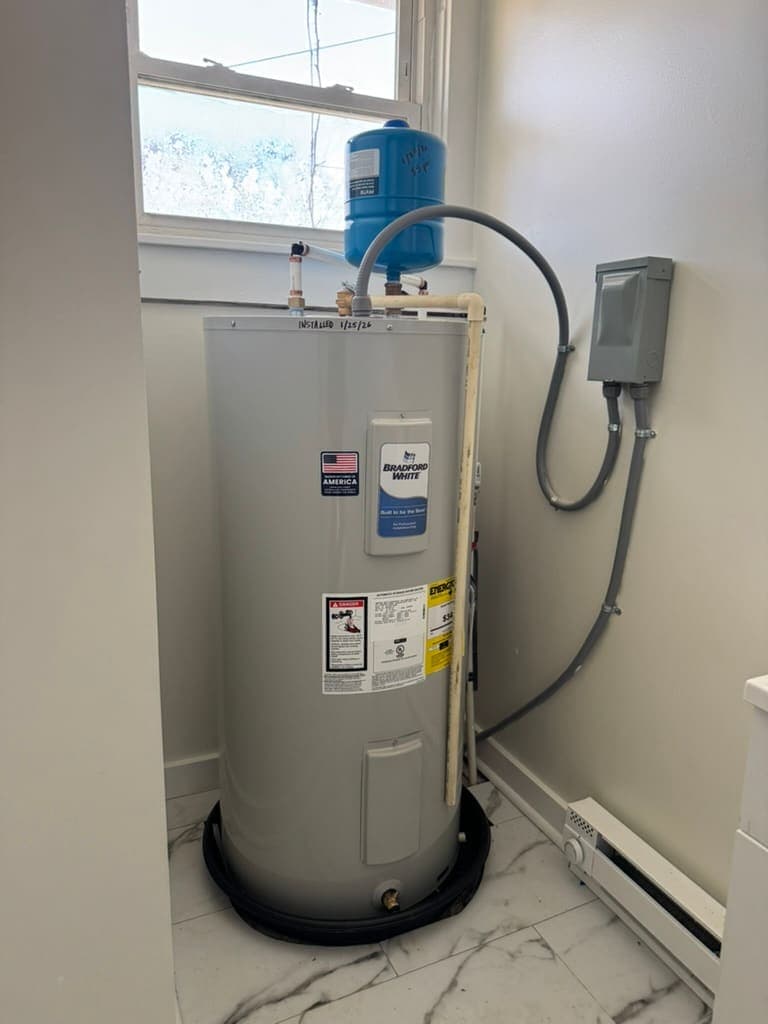
Most tank water heaters last 10 to 15 years. When a unit is leaking, failing repeatedly, or near the end of its life, replacement is usually the better investment. We install gas and electric tanks in 40-gallon, 50-gallon, and larger sizes, connect them to your existing water and fuel lines, and bring the installation up to current code. That can include an expansion tank, a drain pan, and a properly piped relief valve.
We haul away the old unit when we're done. Estimates are free for many water heater installations.
Tankless water heaters
A tankless water heater heats water as you use it, so you don't run out during back-to-back showers, and it takes up far less space than a tank. It is also more demanding to install. A gas tankless unit needs a gas line large enough to supply its full burner capacity, plus dedicated venting. An electric unit often needs added electrical capacity.
We size tankless units to your household's peak demand, meaning how many showers, faucets, and appliances may run at once. Before recommending a model, we check your gas line, venting, and water quality. If your gas line is too small, we can replace it as part of the same job.
A well-maintained tankless unit can last 20 years or more. It needs periodic descaling to remove mineral buildup from the heat exchanger, especially on well water. We service and repair existing tankless units as well as install new ones.
Tank, tankless, or hybrid: which fits your home
A standard tank is the simplest and least expensive option to install, and it is often the right choice for a direct replacement. Tankless is a good fit for households that run out of hot water or want to free up space, as long as the gas or electric service can support it. A hybrid heat pump water heater uses far less electricity than a standard electric tank, but it needs more room and a space that stays between about 40 and 90 degrees year-round.
We explain the cost and trade-offs of each option for your house. The decision is yours.
Marcel and Tooley came out on a Saturday evening and fixed my water heater by replacing the elements and thermostat — for $100. That saved me from a nearly $10,000 quote elsewhere. Honesty, knowledge, and professionalism.