
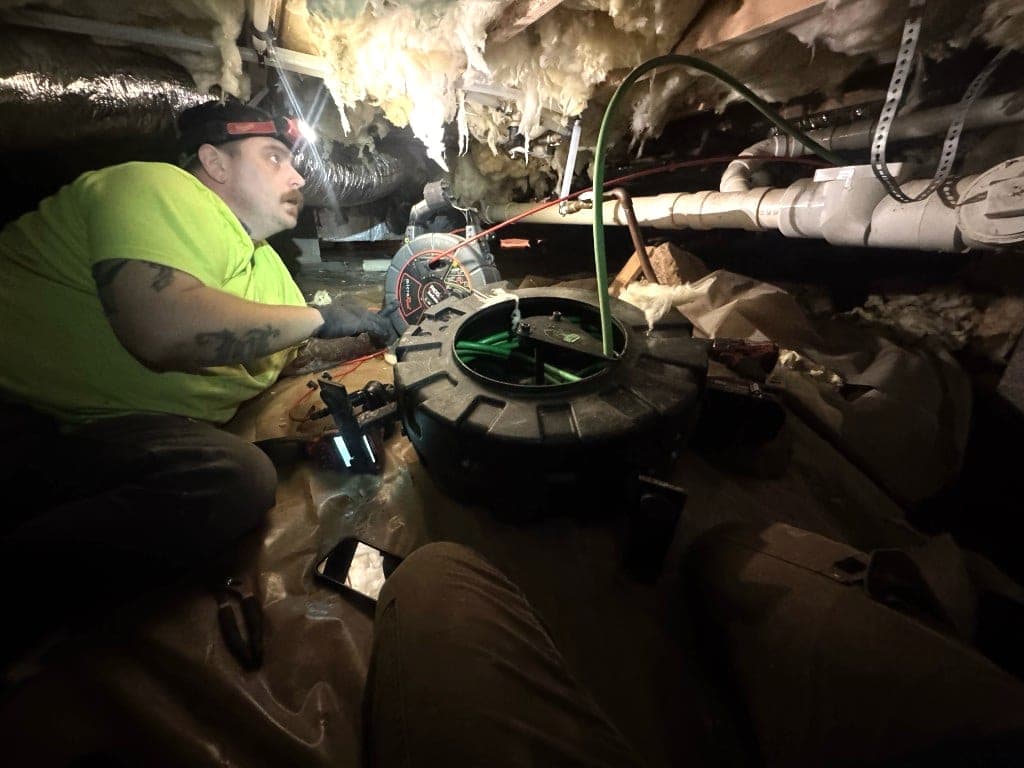
What a sewer camera inspection shows
The camera is a small, lighted lens on the end of a flexible cable. We feed it into the line, usually through a cleanout, and watch live video on a monitor as it travels toward the sewer main. A counter tracks how far the camera has gone, so we know how far down the line each problem is.
The footage shows roots growing in through joints, grease and scale on the pipe wall, cracks and breaks, joints that have shifted out of line, sags that hold water, and sections that have collapsed. It also shows what the pipe is made of, whether that is clay, cast iron, Orangeburg, or PVC, and where one material changes to another.
A sewer scope before you buy a home
A standard home inspection covers the plumbing you can see. It does not look inside the sewer line, which is buried in the yard and is one of the more expensive parts of a house to replace.
Many homes in Asheville's older neighborhoods still have their original clay or cast-iron sewer lines, and mature trees send roots into them. A camera inspection during your due diligence period tells you whether the line is in good shape, needs cleaning, or needs a repair, while you can still factor that into your decision.
We go through the footage with you and tell you plainly what we saw and what, if anything, needs to be done.
What happens after the inspection
There are three common results. The pipe is in good condition and the clog was the whole problem. The pipe is sound but coated with grease, sludge, or scale, and a thorough cleaning will restore it. Or the pipe itself is damaged, and no amount of cleaning will keep it open.
If the line is damaged, we show you where and how badly. One bad section can often be repaired on its own. A line that is failing in several places usually needs to be replaced. You get both options when both make sense.
What a camera can't do
A camera can't see through standing water or a full blockage, so a backed-up line has to be cleared before it can be inspected. It also can't pass every fitting. Tight bends and some older traps stop it, and we tell you if a part of the line couldn't be reached.
A camera also doesn't fix anything. Its value is that the repair or cleaning that follows is based on what is in the pipe, and you have seen it for yourself.